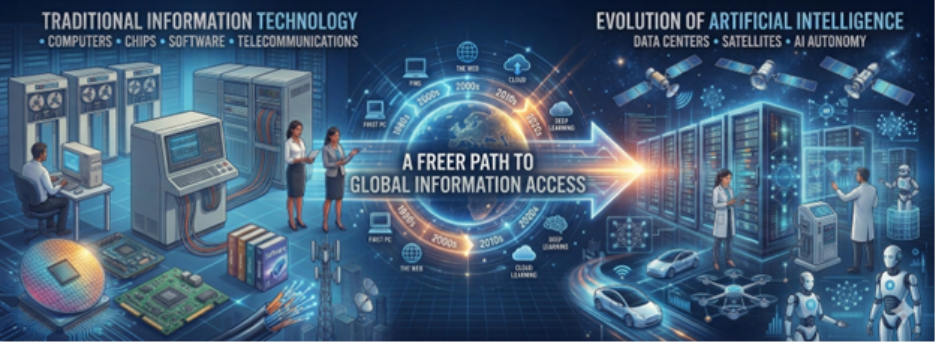
The Information Technology Agreement
December 1996: A pivotal time in history. Geopolitically, the Cold War had ended, former rivals were redefining relationships, and governments increasingly saw economic cooperation as critical to international stability Technologically, computing was moving from corporate data centers into homes, schools, and small businesses, while the internet was evolving rapidly from an academic network into the foundation of a new global information economy, And economically, rapid globalization emphasized that information itself had become an economic asset requiring new economic rules and structure.
In that December, the world’s trade ministers met in Singapore to inaugurate a new structure to supplant the General Agreement on Tariffs and Trade (GATT) for rules governing international trade in goods. GATT rules would remain legally binding, but the new World Trade Organization (WTO) would serve as the new framework for international trade in goods and other areas of commerce.
But how would the WTO respond to this convergence? One answer: Structure trade rules to reflect the technology revolution developing in the global marketplace. Those of us in the information industry, with substantial US government support, suggested the need for a new framework called the Information Technology Agreement (ITA).
Prior to the Singapore meeting, trade ministers almost always rejected the idea of crafting trade rules for specific industry sectors, The ITA changed that. Surprisingly, the first formal agreement negotiated by the fledgling WTO specifically addressed the needs of one broad industry sector. The IT industry required new rules to keep pace with the de facto revolution happening in the global economy.. Reaching agreement relied on technical expertise, determined negotiation, trust, willingness to share credit, and understanding that long-term benefits should outweigh short-term political or commercial advantage. Competitors found common cause. Government agencies worked across traditional institutional boundaries. Officials from different countries searched for practical solutions, not rhetorical victories. Above all, consensus was needed that information itself is a critical asset requiring priority attention.
Today, the world again stands at the threshold of another technological revolution. Artificial intelligence, advanced semiconductors, cybersecurity, digital infrastructure, and cross-border data flows present policy questions that no nation can address by itself. The Information Technology Agreement – not just its provisions, but how it was adopted – may serve as a useful precedent on how officials and business can proceed.
*** The ITA’s Roots
– A Mosaic of Global Trade Practices and Initiatives
Trade of goods, services, and ideas has been a fundamental part of human activity almost since the dawn of civilization. People make things. Other people buy them. And commerce established by these makers and sellers brings enrichment to both sides of the equation. As nation-states became more well-established, traders like Marco Polo brought the richness of Asia to Europe, Arab mathematicians and scientists transmitted important new ideas across cultures, and explorers started to move goods, people and culture across oceans.
Things took a remarkable turn with the two World Wars of the 20th century. Their aftermath brought a remarkable transformation to global commerce, especially with the advent of multinational corporations. Trade became ubiquitous – no longer something done most frequently on a one-off basis. And because of that, industry needed a system by which trade would happen most efficiently, especially as goods moved across borders. Governments responded by creating increasingly standardized rules, classifications, and international frameworks that allowed national customs systems to interact..
Of principal interest was how border officials would address three factors that are essential for knowing how to collect customs duties on shipments or other forms of product transfers. The three most important factors were, and continue to be –
Classification – What a product is.
Country of Origin – Where the product is made
Duty Rate – The appropriate charge to be levied when a product enters a country.
To be sure, there are other factors. For example, there are duty free shop items that international travelers are familiar with, items of art for which determining actual value are nearly impossible to establish, and others.
But in the realm of international commerce, product classification, country of origin, and applicable duty rates form the administrative mosaic in which government and business officials must work together. Governments made progress in the post-World War II era by institutionalizing the three critical factors. We will describe how that progress was made and its impact on the computer, telecommunications, semiconductor, and technology industries.
And yet, even with that progress, a revolution started in which information technology began to break the assumptions on which those basic rules operated. Information itself became a commodity, treasured around the world. The required mosaic for this new kind of trade would become a collection of tariff rules, classification systems, bilateral agreements, regional agreements, industry initiatives and government initiatives that ultimately had to be assembled – or in some cases dismantled – to create something that had never existed before – the Information Technology Agreement.
– What Was at Stake
By 1990, personal computers were still a relative novelty. The graphical user interface (icons) introduced by Apple was still unfamiliar. What we now call “gamers” were just graduating from “Pong” and “Space Invaders”. Computer networking was still in its relative infancy, and the Internet itself was just beginning to move from government and academia to corporations. Social media was still unheard of, and corporate investments in computing was earmarked mostly for mainframes and workstations.
Global trade in what was then the early information industry (computer hardware and software, semiconductors, telecommunications products) was nevertheless set to explode in the early 1990s. The major players at the time were the United States and Japan. According to statistics from WTO (and earlier GATT) data, world exports of relevant industry sectors totaled nearly $300 billion, with the U.S. accounting for about $52 billion. The total value would total about $600 billion by the mid-90’s and all projections from there pushed higher at even faster rates. For semiconductors alone in 1990, sales (not pure trade flows) stood at about $60 billion with U.S. companies holding about 35% of the global market by sales and Japanese firms held around 50% (Dataquest). Again, market forecasts pointed dramatically upward.
The stakes were high. Technology leadership, economic growth, job creation, and national security were the stakes on the table. While the institutions of government were reasonably equipped for the world that they had been designed to govern, technology was changing faster than those institutions were designed to accommodate.
– The Legal and Institutional Framework
In reality, government institutions were relatively well-positioned to address the growth in trade for this sector. Classification, rules of origin, and duty rates were embedded deeply in the international trading system. Most of our discussion here focuses on the United States government, but as will be seen, the pace of technology change in information products would soon force major changes globally that would culminate with the ITA.
Major Provisions of US Law –
The Reciprocal Trade Agreements Act of 1934 – Considered the blueprint for modern U.S. trade policy, this act shifted authority to negotiate tariffs from Congress to the President, allowing the executive branch to negotiate bilateral, reciprocal tariff reductions with other countries, thereby ending a period of US protectionism
The Trade Expansion Act of 1962 – Gave the President authority to cut tariffs by up to 50% in international negotiations and set up the Office of the Special Trade Representative (USTR) to lead international trade talks.
The Trade Agreements Act of 1979 – Approved the agreements reached during the Tokyo Round of trade negotiations and acted as the vital catalyst for modernizing and officially establishing the Office of the United States Trade Representative (USTR). USTR’s jurisdiction was centralized and expanded, giving it responsibility for developing, managing, and coordinating U.S. international trade policies and negotiations.
North American Free Trade Agreement (NAFTA) Implementation Act of 1993 – Implemented NAFTA, one of the largest trade zones in the world by eliminating almost all tariffs between the U.S., Mexico, and Canada. Agreements reached in negotiating NAFTA would become pivotal as the U.S. Government considered its approach to key elements of the ITA.
The Uruguay Round Agreements Act of 1994 – The Uruguay Round produced the WTO framework, and this Act implemented the United States’ obligations to those agreements establishing the framework.
Key Parts of the US Government on Trade Policy –
Congress – Both houses of Congress must approve the negotiating authority for USTR before formal trade agreements are reached and USTR forwards its agreements to Congress for review and approval. Key committees in the legislative branch are the House Committee on Ways and Means and the Senate Finance Committee.
The U.S. Trade Representative – As noted, the Office of the USTR has had principal negotiating authority for trade with US trading partners since 1962. Fifteen years later, it became a Cabinet level position reporting directly to the President. Agreements that it reaches with trading partners regarding trade in goods and services, as well as non-tariff barriers such as those in the area of intellectual property rights do not become effective until approved by Congress.
The U.S. Treasury Department – Treasury, at least until and briefly after the negotiation of the ITA, was responsible for developing and implementing the regulations required by international trade agreements on tariffs and related items.
The U.S. Customs Service – The Commissioner of Customs reported to the Treasury Department until 2002 when it was transferred to the Department of Homeland Security as the Bureau of Customs and Border Protection.
In essence, Congress and the Executive Branch negotiated tariff policy; Customs actually administered the tariff schedules at the border.
International Institutions of Importance to the ITA –
GATT – The General Agreement on Tariffs and Trade served as the framework for global trade from 1947 to 1995. It established a number of pillars including two critical requirements (1) Most-Favored-Nation (MFN)Treatment – the principle, simply stated, that a trade advantage granted to one country must be extended to other members covered by the obligation, and (2) National Treatment – the principle, also carried forward by the WTO, that requires countries to treat foreign goods no less favorably than domestic equivalents once they enter the local market.
The World Trade Organization – The WTO was established as a permanent, legally recognized institution with its own secretariat, headquarters in Geneva, and global legal standing. It incorporated the GATT rules into its own foundational framework, including MFN and National Treatment
All of these laws and regulations, government institutions, and International Organizations played pivotal roles in creating the environment required by industry to address the fundamental changes posed by the technology revolution taking root in the 1990s. But they were only part of the mosaic in which the information industry operated in the period leading up to the 1996 WTO Ministerial meeting in December 1996.
During that period, IBM constituted the largest technology company in the world. Understanding its structure is important for understanding how it chose to position the industry in the eyes of governments in a period of breathtaking technology change.
IBM had two Chief Executive Officers during the 1985-1996 period – John Akers and Louis V. Gerstner, Jr.
Reporting to the IBM Corporation was the IBM World Trade Corporation, comprised of IBM Europe/Middle/East Corp., the IBM Americas/Far East Corp., and IBM Canada Corp.
Also reporting to Corporate Headquarters were the major US operations and staff offices, such as Manufacturing, Marketing, Research, and corporate staff functions like the IBM Governmental Programs Office in Washington, DC. The latter office was my home in IBM during this period.
Within the IBM Manufacturing organization was an important office relevant to the ITA story – the International Purchasing Office and Distribution Center (IPODC) located in Boulder, CO. IPODC’s relations with the Customs Service and Treasury set an important product classification precedent for the major initiatives in trade policy.
Just as IBM Corporation had various operations and staff functions reporting vertically to Corporate Headquarters, each of the World Trade Corporation subsidiaries had mirror operations and staff functions. They reported through their respective vertical organizations, but they received functional “guidance” from their respective Corporate offices.
To be sure, IBM was not alone in working within the mosaic described in these pages. Indeed, the mosaic may be thought of as a three-dimensional mosaic, with a large number of corporations and industry associations combining efforts to achieve a common goal – the transition of government trading rules and institutions to a global information revolution. How they came together to achieve that goal – that is, how industry and governments cooperated (and frequently disagreed) – comprises the balance of this study.
The ITA’s Roots
– Apparently Unrelated Pieces
Sometimes, things that seem to come together perfectly emerge from what appear to be completely unrelated. An example: In 1957, two American physicists at the Johns Hopkins University Applied Physics Laboratory (APL), William Guier and George Weiffenbach, had a series of lunches. The Soviet Union had just launched Sputnik and, just out of curiosity, they tracked its radio beeps. As Sputnik flew past, they noticed the shift in the signal known as the Doppler Effect. Seeing that, they concluded that if they knew their position on Earth, they could track Sputnik’s exact path. Their supervisor, Frank McClure, a deputy director at APL, suggested that they flip their math. He reasoned that if the satellite’s exact position was known using precision clocks, you could pinpoint exactly where you were on Earth. Meanwhile, Gladys West, an African-American mathematician at the Naval Proving Ground, used complex calculations to enable mapping the exact shape of the Earth. The outcome? Converging physics, applied mathematics, space-race paranoia, and precise timekeeping enabled what was at first a simple tracking hobby into the GPS, which now navigates every smartphone, airplane, family car, business truck, and rescue team on the planet.
The GPS example illustrates a point. Sometimes, good things happen when apparently unrelated events or discoveries come together in unexpected ways. In any jigsaw puzzle – or Mosaic – puzzle solvers start by finding the corner piece, then the outside pieces, then interior pieces that follow certain lines or colors, and finally the last piece that completes the picture.
Similarly, the Information Technology Agreement (ITA) started with disparate pieces of trade law and practice trying to find structure against a backdrop of rapid – even revolutionary – technology change. Indeed, business itself was adjusting its practices to adapt to this change in a world where trade rules were becoming increasingly obsolete. At times, what was going on bordered on the comical. But at all times, events were pointing in one direction: A new set of rules was essential to progress. In the US, immediate changes were required in the way imports and exports were treated. That was the two dimensional part of the mosaic. The third dimension – getting the entire information industry and government policy working together at a global level – would spell the key to success. Fortunately, information industry executives in the United States recognized the need for change and they began to look for ways to communicate that need to policy-makers. And just as fortunately, key government officials began to see the problem and worked together – even at a bipartisan level – to do what was needed.
But before those pieces could come together, several longstanding problems had to be resolved– and some entirely new approaches to trade policy had to be tested.
In truth, major government policy changes in the final quarter of the twentieth century would have a profound impact on International trade. During that time, these policies and practices would affect the information technology industry –
Product Classification under a new Harmonized System (HS)
Greater focus on customs rules of origin
The U.S.-Japan Semiconductor Agreement
The Canada-U.S. Free Trade Agreement
The North American Free Trade Agreement
At the time, these developments appeared to have little to do with each other. Looking backward, however, they begin to look remarkably connected.
Product Classification
Sometimes, we get lucky. We do something for a perfectly good reason and it works just fine. Later, something even better comes from our initial effort. That, for example, happened in 1968 to Spencer Silver, a chemist at 3M Corporation. Silver developed a new adhesive, but it was relatively weak and 3M couldn’t identify a practical use for it. Eight years later, a 3M scientist named Art Fry was frustrated when his bookmarks kept falling out. He remembered Silver’s adhesive and thought it might be a useful bookmark that would stick to a page, but could be removed and repositioned without damaging it. 3M bought his idea, calling the new bookmark “Press ‘n Peel”. Now, we know it as the Post-it Note.
In some respects, the history of the Information Technology Agreement is the story of unrelated pieces coming together in much the same way. One of the clearest of those pieces was how government officials around the globe decided to change the way products in trade should be classified by Customs authorities. They decided that change was needed in classification procedures, but their primary interest in change was for bureaucratic administrative reasons. What they ended up with would be transformative for trade in IT products.
By the late 1960s, governments, international organizations and the trading community recognized the need to rationalize and harmonize trade documentation data, especially in the areas of commodity description and coding. Differing national systems and interpretations of what was then called the Customs Co-operation Council Nomenclature (CCCN) caused friction, higher costs, delays, and difficulty in compiling statistics or conducting tariff negotiations. The United States, in particular, operating under a classification system called the TSUS (Tariff Schedules of the United States) was especially out of step with other countries.
There’s no need here to go through the details of how the new Harmonized System (HS) was developed. But it’s important that President Reagan very early on recognized the need to prepare the US Government for its adoption and implementation. He directed in 1983 that agencies be prepared for implementation within 5 years. In actual fact, after some Congressional delay, the U.S. implemented the Harmonized Tariff Schedule effective January 1, 1989, pursuant to the Omnibus Trade and Competitiveness Act of 1988. The timing of the U.S. actions is important, because relations established by companies like IBM and the Treasury Department and Customs Service in that period were pivotal. Important issues were resolved and processes established that would form key elements that would eventually become the ITA.
For example, the old system was too broad and lacked the granularity needed for freight documentation, trade statistics, and other purposes. In one case, a single commodity could be described or coded in up to 17 different ways during the course of one international transaction, covering from the point of manufacture to the final import of the commodity itself. Under the Tariff Schedules of the U.S. (TSUS), product classifications were made under a 5 digit code system that differed from the old CCC nomenclature, causing confusing and sometimes humorous conflicts. In one apocryphal case, one American company, not quite understanding how the wires that it was importing should be classified due to their unique nature, listed them on their declaration form as “spaghetti”.
Such cases were the exception to the rule, to be sure, but pointed to the need to move from the 5-digit TSUS system to the HTSUS and its 6-digit format for Customs use (actually, the HTSUS went to a 10-digit format for more precise statistical keeping reasons). Transitioning from the old system was important, and there was no official grace period for importers. Importers were required to go to the new system overnight on January 1, 1989. To be fair, Customs did allow an “adjustment period” in which administrative leniency was permitted to allow many importers to adjust to the new system.
However, one company ran into problems with the U.S. Customs Service during the adjustment period, resulting in a massive exposure in terms of duties and potential penalties for filing improper import documentation. That company was IBM. And the products in question were the motherboards of computers.
IBM and the Motherboard Classification Issue
At the same time that the U.S. Customs Service was switching to the HTSUS, IBM’s Manufacturing department informed the company’s Governmental Programs Office in Washington that a major disagreement had shown up. Customs had shifted its classification of motherboards aggressively in actions targeted at high tech imports from Japan, Taiwan, and Singapore. Whereas IBM (and other importers) had been describing these printed circuit boards as “computer parts”, the Customs Service said that they should be classified as “unfinished computer machines”.
This was not mere semantics. As “computer parts”, these items would be subject to duty free treatment; i.e., a 0% tariff rate. If the Customs position held, the rate would be 3.9%. While the difference in rates seemed small, the financial impact of the change would be significant. And if Customs were to charge the company with deliberately mis-characterizing these imports, very substantial penalties could have been imposed. The risk to IBM represented tens of millions of dollars in unpaid duties and potential penalties.
The IBM Import Procurement and Distribution Office (IPODC) in Boulder, Colorado, a relatively new organization within iBM Manufacturing, became critical to resolving the issue. The IPODC explained the nature of the problem, telling those of us in the Washington Office that the Customs policy represented a major threat to the way IBM processed these imports and, consequently, an unacceptable expense. They explained to us that motherboards brought into the U.S. had always been classified as parts, not computers of any sort – unfinished or finished. We initiated a series of contacts with the Customs Service, but their stance remained firm. Failing to get their support, we therefore went up the reporting chain — Customs reported to the Deputy Assistant Secretary for Regulatory, Tariff, and Trade Enforcement in the Treasury Department, John Simpson.
Simpson supported the Customs position when we first met him, but he offered a possible way out. Under Customs practices, he suggested that we might be able to establish that IBM had followed an “established and uniform practice” by declaring on our import declarations that our motherboards were “computer parts”. But in order to get Customs to change its position, we must present clear and indisputable evidence that we had followed such a practice.
Having received Simpson’s offer, we did research to verify the importance of the phrase “established and uniform practice”, or EUP. We discovered that EUP had a long history in law and practice in Customs administration. In fact, as we looked at it, EUP seemed to work to help importers. It seemed to protect importers’ reliance interests by requiring notice before a higher rate of duty is imposed based on a departure from consistent prior treatment. The phrase entered into the U.S. Code via the Customs Administrative Act of 1938.
Importantly, the phrase applied to administrative ruling, not statutory changes. Originally, the law required a 30-day delay after Federal Register publication before a higher rate could apply. Importantly, the Court of International Trade, its predecessors and other courts held that a EUP could exist without a formal Secretary finding. This is referred to as a de facto EUP. In 1959, the Customs Bureau established an administrative procedure designed specifically to identify and review existing uniform classification practices. Eventually, as the TSUS became effective under new law, Customs replied in a case involving sand timers that EUP requires “positive” evidence of uniform treatment. Of interest was the fact that now, Customs could require importers to submit proof of an EUP to discount an importer’s treatment of a lower tariff rate.
We found that to be disturbing, since evidence required by Customs in the period when the US was making the transition to the TSUS would not be helped by the transition to the HTSUS. We had hoped that since Customs was engaged in an “adjustment period” as the US switched to the new classification system, we could establish a pretty good case that we had followed consistent classification practices and that might suffice. But when we approached Customs, officials there informed us that the key word in our case wasn’t “established” practice, but “uniform” practice. We had to prove that 100% of our entries over time had been accepted by Customs authorities at the ports as “parts”.
That was a tall order, challenging at best, and almost impossible to prove due to the scope of what we had to prove. Fortunately, and almost by accident, exactly the right organization in IBM had been established within the previous two years to maintain and digitize Customs entry records – the IPODC. We explained the situation to IPODC, They shook their heads in virtual disbelief. What Customs was requiring would require the search for, analysis of, and validation of over 100,000 entry documents And every one of them had to declare that IBM was entering the motherboards as computer “parts”.
If the records had been digitized already, running a search would have been easy. But Customs entry forms had yet to be updated in the IBM recordkeeping system. IPODC had a warehouse of forms for motherboards and tens of thousands of other imported items. To do what Customs demanded required a manual search. To our surprise in the Washington Office, IPODC committed to do the search. It took several dozen employees a couple of months to find the relevant entry documents. They worked in shifts over 24 hour periods. They sorted out the right entries, found how classifications had been declared, and organized them into a newly established database that would be used to generate reports that would be presented to Customs officials. One complication? Some of the entry declarations were filed under the HTSUS system while most had been filed under the TSUS.
All the data was accumulated, organized, and set out in a printout of several hundred pages with over 50 lines per page. The data was conclusive. EVERY entry of IBM motherboards had consistently classified them as parts at multiple ports of entry. The practice had indeed been uniform. The Customs Service accepted the data and ruled that IBM could continue to classify the boards as parts at a 0% tariff rate.
Conclusion of the motherboard case: Yes, the effort paid off. No additional duties were imposed or penalties imposed. Importantly in this case, two unrelated pieces were coming together: (1) The international community’s effort to create a common classification system, and (2) IBM’s very practical fight over how its motherboards should be classified. And neither of these was undertaken with the ITA in mind. That said, IBM’s problem forced the company to understand classification at a level it probably never expected to need. And in solving that problem, IBM developed relationships and institutional knowledge that would matter later.
The ITA was still years away, and nobody involved in the motherboard case had it in mind. But a critical piece of the eventual puzzle was now in place.
Product Rules of Origin
When production becomes international, tariffs create a second problem. Governments must decide where a product “comes from.” And importantly, making that determination must be clearly defined for use by exporters and importers, and simple enough not to cause administrative headaches and reflective of their need for speedy and cost-effective decision-making.
We don’t think about it much. We put on a shirt in the morning and we may or may not see the label – “Made in Portugal”. But in truth, that’s misleading. The raw cotton was grown and harvested in India. The raw cotton was shipped to Turkey to be spun into yarn. The yarn was sent to Pakistan to be woven into sheets of fabric. The fabric was transported to China to be dyed and treated. The dyed fabric was shipped to Portugal, where it was cut into patterns and stitched together. Because the final cutting and sewing occurred there, the shirt gets a “Made in Portugal” stamp, ignoring the fact that 90% of the process of making the shirt occurred outside Portugal.That seems clear enough. But when it comes to import law, the origin of a product is very different. And that can impact the price we pay for the shirt we buy in a store.
The problem of determining the origin of information technology was much more difficult since a single computer could contain components manufactured in a number of countries, assembled in another, and shipped through yet another. While we address actual reduction of duties under the ITA in the following section, several international trade agreements were reached on a regional basis. Each would address rules of origin in differing ways, and yet their evolutionary progression would eventually become part of the critical essence of the ITA. Those agreements included –
The U.S.-Japan Semiconductor Agreement
The U.S. Canada Free Trade Agreement
The North American Free Trade Agreement (NAFTA)
The U.S.-Japan Semiconductor Agreement
Economic war broke out between the United States and Japan in the 1980s. The war’s battle lines were drawn at the corporation level, but both national governments were deeply involved. In 1976, Japan launched the VLSI Very Large Scale Integration) Project, pooling research efforts by companies like Toshiba, Fujitsu, and Mitsubishi. The VLSI project helped to promote Japanese competitiveness in semiconductor development and manufacturing, and by the mid-80’s, Japanese manufacturers controlled over 50% of the world’s memory chip market.
Losing market share to the Japanese was bad enough, but American competitors believed that their loss of share was due to unfair competition. They leveled two principal charges against the Japanese: First, that US firms were being denied fair market access to theJapanese market due to perceived special relationships between the chip makers and large Japanese corporate buyers. And second, the U.S. industry alleged that the Japanese were selling chips in the U.S. and other markets below their fair market value or below the prices that were charged in Japan.
They were fighting on an uneven playing field, the American manufacturers said, especially in the field of memory chips. The Semiconductor Industry Association (SIA) filed a complaint in the U.S. alleging that the U.S. firms were being denied access to the Japanese market. And companies like Micron, Intel, AMD, and National Semiconductor filed dumping charges involving several kinds of memory chips.
In Washington, the Semiconductor Industry Association filed a formal petition in June 1985, accusing the Japanese government of creating a protected cosmetic cartel and restricting U.S. companies’ access to Japan. Meanwhile several U.S. companies (such as Micron Technology) and the U.S. Commerce Department accused Japanese companies of dumping memory chips in the U.S. and global markets at prices far below production costs, thereby driving American companies out of business.
This combined attack, whether planned jointly or not, threatened Japan with retaliation by the U.S. and potential massive anti-dumping duties. Japan’s Ministry of International Trade and Industry (MITI) was forced to the bargaining table. The negotiations transpired at almost breakneck speed, as the historic U.S.-Japan Semiconductor Agreement was signed 15 months later in September 1986.
The Semiconductor Agreement provides a major contrast between how information technology trade was addressed by government authorities in 1986 and how their overall approach changed a decade later with the ITA. For example, the Semiconductor Agreement formed a “managed trade” framework that was meant to avoid tariffs by establishing price-monitoring mechanisms and market access targets. Tariffs themselves were largely avoided in the agreement, except for the potential that they might be levied as retaliatory penalties for agreement violations. Without going into detail about the agreement’s provisions, it is worth noting that President Reagan did impose such penalties in the form of 100% tariffs relatively soon after the agreement was signed.
Yes, this agreement showed one way governments could respond when an emerging technology industry created trade problems: Governments could intervene, negotiate targets, monitor prices, and threaten retaliation. But fundamentally, that approach ran directly counter to what the IT industry ultimately needed.
This was the bottom line: The lesson was not that government has no role when dealing with this kind of trade issue that arises due to an emerging technology industry. The real message to be gleaned from the Semiconductor Agreement was that governments must create rules that allow industry to operate most effectively and on the most cost-efficient basis, rather than rules that attempt to manage the industry.
The Canada-U.S. Free Trade Agreement (CUSFTA)
As a point of fact, trade cooperation was in store for two countries – the United States and Canada – at almost the same time that the U.S. and Japan were engaged in confrontation. In the U.S./Canada case, the move to cooperate covered all products, not just IT products. And importantly, the CUSFTA agreement introduced groundbreaking ideas: (1) Tariff elimination can serve as an instrument of economic integration; (2) sectoral liberation can work; and (3) rules of origin can be made more objective through tariff classification.
Historically, Canada was concerned about becoming too dependent on the much larger market to its south, while at that time, the U.S. tended to view the Canadian market as a key cog in a more integrated North American economic engine. Brian Mulroney had been elected Prime Minister in 1985 favoring closer ties to the United States, and American President Ronald Reagan embraced the Canadian position favoring market-oriented trade liberalization. Importantly, THREE countries were becoming more attuned to the importance of moving computer parts across their respective borders – Canada, the U.S., and Japan.
Things in the information technology trade were changing. For example, manufacturing and assembly of computer products in the three northern Pacific countries was assuming new importance. The producers of these products needed to lower costs as parts criss-crossed borders for assembly and manufacturing. Since Canada had some of the highest tariffs on these parts ranging from 3.9% to 6.9%, their cooperation with Japan and the U.S. was regarded as critical On November 22, 1985, Canada joined the U.S. and Japan in signing a trilateral computer parts pact. The agreement completely eliminated tariffs on computer parts – including computer terminals and printers to basic logic units and semiconductors.
Negotiations for Canada-U.S. Free Trade Agreement, or CUSFTA, began in 1986. The agreement was signed in January 1988 and entered into effect on January 1, 1989. It made sense. Trade between the two countries was already extensive, but tariffs and other barriers brought misallocation of production. Put simply, these barriers kept the two countries from operating as an integrated market since U.S. tariffs had averaged about 3 percent, while Canadian tariffs stood at roughly 5 percent.
The key difficulty was deciding what U.S. and Canadian-origin goods qualified for preferential treatment. Bear in mind that for many years, customs officials in all countries made what were in effect subjective decisions on determining a product’s origin. Without going into too much detail here, it’s enough to say that customs authorities moved toward a more objective approach as late as 1973, with the adoption of the “Kyoto Convention”. In that agreement, authorities adopted a standard called “substantial transformation,” indicating that a “Change in Tariff Classification” (CTC), also called a “tariff shift rule” should be used to determine origin. Not much happened with it since a unified customs classification system used by all countries wasn’t in place yet. It took 15 more years before the Harmonized System, or HS went into effect.. The HS created standardized 2-, 4-, and 6-digit codes to identify and classify products.
In a fortunate coincidence, the CUSFTA was signed in that same month – January 1988 – and went into effect a year later. With it, a few tentative steps were taken that started the members down the road to adopting the “tariff shift rule”. The agreement also included a 50% local content rule, but the CTC rule became much more important in a few years. Through its adoption, the rule required that imported parts and components had to be processed and assembled so significantly that the final product must be classified under a completely different Harmonized System (HS) tariff heading at the 6-digit level in order to qualify for zero tariffs. This change in rules of origin for eligible products under the CUSFTA set a standard for future trade agreements.
In its simplest terms, CUSFTA –
eliminated tariffs progressively on virtually all products involved in the bilateral trade. Many tariffs were reduced to zero immediately, while others were phased out at different intervals over the next decade;
proved that sectoral trade liberalization can work, an issue about which trade negotiators in GATT and the early WTO were skeptical. The agreement gave U.S. and Canadian negotiators a good test run proving that the complete elimination of tariff barriers on highly sensitive, high technology sectors would NOT destroy domestic industries. Instead, no tariffs meant lower production costs; hence, more competitive manufacturers; and,
it established a blueprint for rules of origin, since the member countries had to decide exactly how much of a product must be made in the two countries to qualify for zero tariffs. As Japan was also a member of the 1985 agreement, U.S. and Canadian officials had to determine how to track high-tech supply chains. Applying the Change in Tariff Classification approach was the answer.
Each of these would significantly impact both the subsequent NAFTA agreement and the ITA.
The North America Free Trade Agreement (NAFTA)
Governments were starting to shift trade policy to reflect the rapidly changing high technology marketplace. Regional preferential trade agreements were tested successfully. The new Harmonized System of classifying products showed promise. And the tariff shift approach to rules of origin also seemed to work. The question now was how to tackle the tough issue of actual tariff rates.
In reality, the push for a North American trade bloc started somewhat anemically in President Reagan’s 1979 campaign platform. Nothing much came from that for a while, But in 1990, Mexico, like much of Latin America, suffered in a debt crisis. To fight it, President Salinas worked aggressively to attract foreign investment to stabilize and modernize the Mexican economy. And in 1990, President Salinas approached President George H.W. Bush to suggest that negotiations begin on a bilateral free trade agreement. Since the U.S. and Canada had already signed the CUSFTA in 1988, Prime Minister Mulroney asked to be included in negotiations, thereby establishing trilateral negotiations that would lead to NAFTA.
As noted, Mexico had been trying to incentivize its domestic assembly sectors due to the Latin debt crisis. As part of its program, the country had imposed highly protective trade barriers on technology and electronics. In fact, while it had eliminated previously existing strict import licensing requirements which had protected its domestic production, Mexico had simultaneously increased tariff rates in April 1991 on information products from 10 or 15% to the following levels:
Personal Computers — 20%
Peripheral Equipment — 20%
Electronic Components & Subassemblies — 15%
Telecommunications Equipment — 20%
Just to be clear, the final NAFTA agreement addressed trade in all products, not just those of the information industry. The final agreement tackled a wide array of issues, not just tariffs, including environmental protection, labor laws, intellectual property, and numerous other areas of trade law. And, NAFTA did focus on gradually phasing out and eventually eliminating all goods traded between the three member countries by 2008.
What NAFTA did with electronics was unique and a seminal ingredient of what eventually happened in the Information Technology Agreement (ITA). Yes, the agreement systematically eliminated Mexico’s high protective tariffs on electronics, telecommunications equipment, and computers. Thus, U.S. components could be shipped efficiently into Mexico for final assembly thereby reducing the cost of finished electronics. The agreement therefore adopted very tight rules of origin. Certain items, like computer parts, televisions, and semiconductors were required to have a specific percentage of North American parts or substantial transformation in order to qualify for duty-free treatment among the three countries.
These rules, as they were being discussed before final agreement was reached, caught the attention of major high-tech companies. CEOs, having been briefed by their own manufacturing and those in their companies responsible for customs compliance, saw that these rules did not truly reflect the dynamics going on in information technology. Compliance with the rules would be difficult enough, but components and subassemblies trade was so intertwined at different levels in different countries, the proposed rules of origin based on value of parts and assemblies really didn’t make sense.
The companies stepped up. The CEO’s of a number of companies told the U.S. Trade Representative that the rules were impracticable and threatened to make NAFTA extremely difficult to comply with at best, and possibly completely impracticable at worst. The Washington offices of these companies started to push the case with the key stakeholders among Washington politics – the USTR, the Customs Service, the Commerce, State, and Treasury Departments, and members of the House and Senate. The effort succeeded in getting the attention the companies wanted, and especially the attention of a couple of key individuals in the Treasury Department and the office of the USTR. Given the almost revolutionary change happening in the information industry, John Simpson of Treasury and the U.S. Commissioner of Customs, Carol Hallett, agreed with industry representatives that something had to be done. Their counterparts in Mexico City and Ottawa agreed as well.
At the eleventh hour of negotiations, Simpson received a few representatives of IBM and other companies to discuss an idea they were kicking around. Could the NAFTA countries take a page out of how the European Union handled tariffs on non-European products? The idea was intriguing enough that Simpson raised the question with his counterparts and they thought it worthwhile enough to go back to their capitals and get instructions. Almost overnight, all three countries agreed to work on the concept, but with substantial differences from European practice. But what they did agree to became a central feature of what would later become the Information Technology Agreement.
At first glance, NAFTA and the later ITA seemed to be very different. NAFTA was a broad regional free trade agreement among three countries, while the ITA would be a much narrower agreement focused on IT products. But the essence of the Simpson proposal modeled somewhat on the European Union practice would prove highly significant – the participating countries could agree on common treatment for certain technology products not only when they trade with each other, but also, in carefully designed circumstances, when those products came from outside the NAFTA members. Unlike the EU, this idea was sector specific.
This was a significant departure from the traditional way that trade agreements worked. Normally, a free trade agreement says, in effect, “We will eliminate tariffs on each other’s products.” But each country remains free to maintain its own tariffs on products coming from the rest of the world. In general, NAFTA followed that model.
But the three countries of NAFTA went beyond the traditional model when it came to certain computers and related products. They agreed to harmonize their treatment of specific products entering from outside North America. In effect, they addressed a question that ordinary free trade agreements could largely avoid – What tariff should a participating country charge when a good comes from somewhere else?
Think about the practical nature of the reasoning. If the three countries kept very different tariffs on imports from Asia or Europe, would it not provide incentives to the companies there to bring products into North America through the country with the lowest external tariff? The eventual NAFTA agreement would demonstrate that tariff liberalization could sometimes require countries to look beyond their own borders and coordinate their treatment of third country trade. The agreement was limited to certain computers and related products, so it was not what is known as a full “common external tariff”, or CXT. But it established a concept: Countries could cooperate on external tariffs as part of a broader effort to liberalize trade in technology products.
Think about the profound change this meant in the logic of trade negotiations. Traditionally, free trade agreements were built around preferences: “I will give your products better treatment if you give mine better treatment.” NAFTA demonstrated something new. Rather than relying on the traditional preferential approach, NAFTA said, “Let’s eliminate tariffs on these products for all participants in the agreement, regardless of where the products come from.”
In this, NAFTA’s limited harmonization of external tariff treatment for certain technology products provided the basis for a sea change in thinking about high tech tariffs. Industry leaders were delighted with the idea. For their companies in the three countries, it addressed the potential problems that NAFTA had posed with the rules of origin and created a much easier and more workable set of policies with which to comply. But perhaps just as importantly, for both companies and government leaders in the three capitals, it removed an incentive for European and Japanese competitors to manipulate external tariffs to their advantage.
By almost any standard of measurement, governments in the late 1980s and early 1990s were moving rapidly to reform international trade and policies affecting the high-tech industry. They were probably not thinking consciously of these efforts as a deliberate effort to keep pace with the extraordinary pace of technological change. Nevertheless, major change was afoot –
The Harmonized System affecting product classification
New approaches to Rules of Origin
The U.S.-Japan Semiconductor Agreement
The Canada-U.S. Free Trade Agreement
The North American Free Trade Agreement
And as part of NAFTA, the introduction of a Common External Tariff for computers and parts
High-tech companies, in general, were pleased with this progress. Government officials, often with industry support, had made large strides toward addressing a number of problems confronting the industry. But at least in Washington, the idea of trade liberalization remained essentially a North American solution to a North American problem.