Moving Forward to the ITA
Long before the Singapore Ministerial, the ITA Coalition realized that traditional political structures were failing to keep pace with explosive technological change. Trade negotiators on both sides of the Atlantic were operating in a vacuum, increasingly detached from fast-moving business realities. Having heard and understood from the business community on both sides of the Atlantic about this problem, U.S. Commerce Secretary Ron Brown and Sir Leon Brittan jointly established a new “bottom-up” forum in November 1995: the TransAtlantic Business Dialogue (TABD) in which corporate CEOs could communicate directly with trade negotiators.
Many observers at the time noted that Brittan viewed the TABD primarily as a personal megaphone to aggressively promote his own, distinct trade agenda. It appeared (and was very likely the case) that he wanted a dedicated corporate cheering section to back his expansive WTO ideas, such as his controversial “Singapore Issues” regarding global investment and competition rules. This strategy was a double-edged sword that worked beautifully when business interests aligned with his goals, but fractured entirely when corporate priorities diverged from his political calculations.
What Brittan certainly did not anticipate was that he helped create a forum that the Coalition would use to create great pressure against Brittan’s own position on the ITA.
In September 1995, Meghan Rainey saw the immense strategic potential of this new forum. She called me to ask if I had heard of the TABD. While I had heard whispers of it, I hadn’t given it much operational thought. Meghan, however, saw a golden opportunity to inject the ITA directly into the upcoming inaugural TABD CEO summit in Seville, Spain, that November.
Her strategy was brilliant in its simplicity: secure a corporate endorsement for the ITA from the CEOs convening at Seville, use that transatlantic business consensus to force the ITA onto the formal agenda of the G-7 Summit in Lyon, France (June 1996), and use that G-7 momentum to leave trade negotiators with no choice but to finalize the deal in Singapore.
To execute this, we called an urgent coalition meeting of Washington representatives. We suggested to our CEOs that putting the ITA squarely on the Seville agenda should be a priority. That would require their enlisting support from key industry leaders from companies not readily identifiable with the information technology industry – leaders like the official U.S. Business Co-Chair, Dana Mead (CEO of Tenneco), alongside steering committee heavyweights like Paul Allaire (CEO of Xerox) and Alex Trotman (CEO of Ford).
Simultaneously, we coordinated with our European corporate counterparts to apply identical pressure on their side of the Atlantic. This was a critical and delicate maneuver because the official European Co-Chair of the Seville summit was Jan Timmer, the Chairman of Philips. The Philips connection was a flashpoint of historical irony. Throughout the intensity of the Uruguay Round discussions, Philips had explicitly joined forces with Siemens to aggressively oppose the elimination of semiconductor tariffs. As we’ve seen. European firms like Philips and Siemens feared the potential of being swallowed up by American and Japanese microchip hegemony, and they had leaned heavily on Sir Leon Brittan to maintain the EU’s defensive tariff wall.
Yet, by late 1995, the ground was shifting beneath their feet. In the pressure cooker of the Seville meetings, the shared commercial frustration on both sides of the Atlantic over bureaucratic red tape began to outweigh old protectionist fears. Timmer famously emerged from the Seville sessions echoing the collective business frustration, stating that there was “absolute agreement that there are far too many rules now, and that they are great and unnecessary impediments to trade.”
The Washington Reaction: Friction Turns to Fuel
When the final Seville Recommendations crossed the Atlantic, the immediate reaction inside the Office of the U.S. Trade Representative (USTR) was a mixture of stunned surprise and intense tactical maneuvering. Wendy Silberman of USTR had been at the TABD meeting in Chicago where Meghan had presented the case for the ITA. Doug Worth and I also went to the Chicago meeting. There we conferred with Michael Dell, CEO of Dell Computer Corp, a key supporter of the ITA and who worked the TABD to get its endorsement. Also at that meeting, we had a chance to meet with Bruno Lamborghini, chairman of Olivetti, chairman of Eurobit, and co-chair of the EU business delegation to the TABD. Over time, Lamborghini’s support for the ITA, and active support for the European offices of our coalition, proved pivotal in getting Sir Leon Brittan to accept the ITA.
Based on the Chicago meeting results, Wendy Silberman began to see a pathway to getting the ITA moving. The first step, which she and Barbara Chattin, counseled us, was to get the ITA on the “Quad” agenda (recall that the Quad was composed of the trade negotiators of the U.S., EU, Japan, and Canada). A meeting of the Quad was scheduled to be held in April 1996 in Kobe, Japan. The Quad was doing preparatory work for the upcoming G-7 meeting the following June, and if the G-7 were to endorse the ITA, it would be put on a fast track for being on the WTO Ministerial meeting in Singapore.
We knew now exactly how to get integrated into the negotiations process.
Meanwhile, Mickey Kantor’s initial response to the Seville meeting had been one of fierce protection of his negotiating turf. Historically, trade policy was the exclusive playground of sovereign governments, and Kantor was highly skeptical – and suspicious – skeptical of private-sector entities operating outside official diplomatic channels. His immediate concern was that the TABD might accidentally dilute Washington’s leverage by giving Europe an easy look at American industrial anxieties. However, as Kantor’s team parsed the final text from Seville, the sheer weight of the unified CEO mandate changed his calculus. Seeing American automotive, paper, and electronics executives standing in lockstep with European giants like Philips and Siemens changed the calculus regarding the ITA. From being a speculative policy regarding the economic realities of the information technology sector, the effect of the Seville meeting was to transform the ITA into a political juggernaut. Kantor realized that Seville had handed him a massive hammer to beat back European protectionism.
Meghan Rainey had been right about the Seville opportunity.
For Charlene Barshefsky, watching the Seville fallout as Deputy USTR, the news was an administrative revelation. She was a meticulous tactician who recognized that the traditional government-to-government machinery was stalling – the essence of her concerns about Sir Leon. The news that Jan Timmer and European high-tech CEOs had signed off on a broad anti-barrier framework provided the exact wedge she needed. In other words, the Coalition had delivered on its promise to face up to Brittan’s stated positions. She immediately saw the corporate consensus from Seville as a way to outflank Sir Leon Brittan. If Brittan tried to block tech liberalization to save his tariffs, he would now be openly fighting his own hand-picked European business elite.
Armed with this corporate mandate, Kantor and Barshefsky shifted their posture from protective skepticism to aggressive adoption. They formalized the Seville text into the official U.S. diplomatic playbook, utilizing the TABD’s momentum to systematically pressure the White House and the European Council.
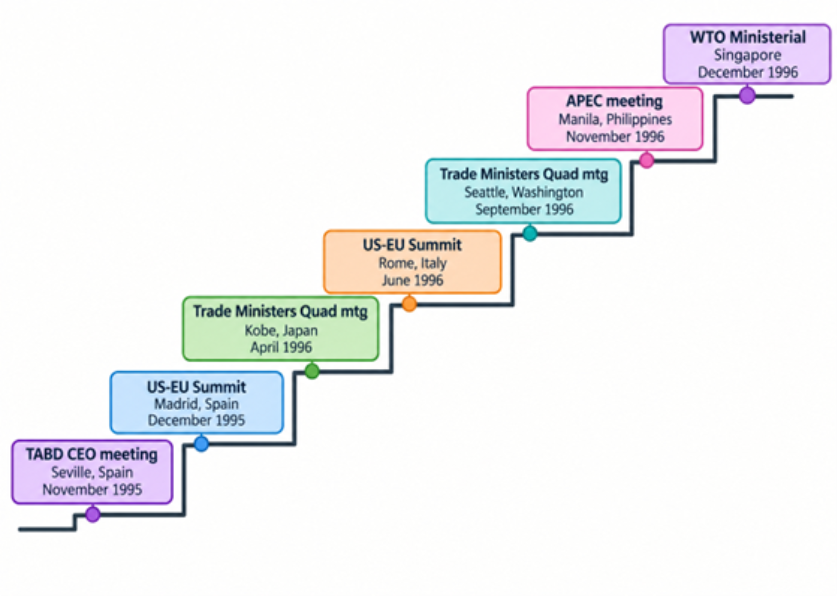
By mobilizing tech giants like Siemens, Ericsson, and Olivetti to sit at the same table with our American corporate allies, the coalition executed a perfectly synchronized pincer movement. We began to use Brittan’s own institutional creation to shift the corporate consensus away from his political posturing. Effectively, the corporate leaders in the TABD process were building a basis for formal ITA negotiations. The ITA’s momentum was starting to become something of a storm surge in trade negotiations. The chart below illustrates the evolution of this highly coordinated diplomatic process, showing exactly how the corporate consensus forged at Seville climbed the ladder through the G-7 into the final text at Singapore:
A Curious Development - And Some Good Fortune
Completely unrelated (at least on the surface) to any consideration of the ITA was the fact that before the Quad meeting in Kobe even took place, the European Union completed negotiations to expand its membership to include the Nordic countries. At this point in time, Sir Leon had not given up on his “old school” line of thought espousing the need for reciprocity in tariff negotiations. As we had seen, his initial problem with the ITA was that it did not demand anything from Japan in terms of item-for-item concessions. When the Nordics joined the EU, they had lower tariffs on IT products than did the EU countries they were joining. Their rates averaged about 1.5 percent, and for Sir Leon, the lack of reciprocity upon the Nordic accession to membership was still a problem.
However, at this time, a leading university in Sweden published a study showing that the administrative costs in collecting such low tariffs actually exceeded the revenue that these tariffs produced. Needless to say, our coalition jumped at the opportunity to ensure that all parties involved in ITA discussions knew about the study. Soon thereafter, Sweden and the other Nordics prevailed on Sir Leon to drop his reciprocity concerns. He did do so in the context of the Nordic accession, but he was far from dropping his opposition to tariff elimination without reciprocal concessions when it came to the ITA.
Not There Yet
Barbara Chattin asked Meghan and me, along with David Rose and Joe Tasker (the two coalition members pulling together the product “landscape”) to meet with her in April 1996. We needed to be aware that Sir Leon had decided to try to use the ITA in a way we had not anticipated. He was, she said, trying to justify using the ITA on the grounds of wanting to demand reciprocal concession.
Fundamentally, he wanted the U.S. and Japan to discontinue the U.S.-Japan Semiconductor Arrangement. Under that agreement, USTR and MITI had agreed to periodic government-to-government reviews to monitor performance of the agreement. Significant data on trade volumes and pricing of chips were shared between the two governments to guard against cheating on agreement obligations. Formal mechanisms were also provided for allowing the semiconductor industries to exchange information.
This, Sir Leon held, represented a de facto semiconductor cartel that discriminated against European chipmakers. He argued that this sharing of information could result in chip prices being set artificially high thereby setting a price floor for global chip sales. Recall that early in his time at the Commission, he was responsible for maintaining the EU as a single market by dismantling cartel activities. So this was a major issue in the making. In fact, very soon, Sir Leon would attempt to pull the rug out from negotiating the agreement completely.
It was time for the ITA Coalition to prove its mettle.
Upon hearing this from Chattin, we quickly organized a call with the Semiconductor Industry Association (SIA), one of our key members. The U.S.-Japanese agreement was under attack and promised vigorous action, including efforts to get EECA in Europe on board with the SIA support for ITA. EECA did not, however, jump on board with our request since they concurred with Sir Leon’s objections to the information sharing parts of the U.S.-Japan agreement.
In the TABD meetings leading up to the G-7 Summit meeting in June, the TABD did not take a position on the EU demand. Nor did the ITA Coalition ask them to do so. Suffice it to say that debate and discussion remained hot and heavy behind the scene. USTR and the Commerce Department told us privately that the ITA discussions kept getting hung up on the issue.
Our work within the global coalition continued during this time. In fact, we even began to use high technology to work to our advantage. During the late 1980s, IBM and a few other high-tech companies had started making email a standard part of our office processes. Yes, email was still relatively new. But in the early to mid-1990s, networking between enterprises on a global scale was just starting to take root. Fortunately, that was the case for our Coalition. Bruno Lamborghini. Chairman of Olivetti and Eurobit, turned out to be a sophisticated user of inter-corporate email. Over the course of several months, he and I routinely exchanged information via email and phone calls – several times a week. We found the exchange extremely helpful – him for his chairmanship of Eurobit and me for mine of the Coalition.
The concept of a global coalition was proving to be invaluable.
As it turned out, the European Commission’s demands for dropping the Agreement occupied the TABS’s center stage leading right up to the June 1996 G-7 summit meeting. The issue was discussed there, and to their credit, the State Department and USTR found a working compromise. The G-7 would support the ITA concept in principle, but that support was contingent on resolution of the EU demand about the U.S.-Japan agreement.
Just one week later, USTR informed the Coalition that Sir Leon had suspended all ITA negotiations on product coverage until the semiconductor issue was resolved.
The semiconductor team inside the Coalition got right to work. USTR had given us only until Labor Day to resolve the issue. While the problem stemmed from Sir Leon’s traditionalist approach to trade negotiations, the issue on the surface boiled down to the ITA’s proposed product coverage. In other words, like during the Uruguay Round, semiconductors posed a major hurdle.
As it turned out, the Coalition was well-positioned. Recall that David Rose of Intel was one of the co-leaders of our product “landscape” effort. David called for support from Daryl Hatano of SIA’s staff in California and David’s Intel colleague Mike Maibach. They in turn, got Andy Grove, Intel’s CEO, involved in direct communications with their industry counterparts in Japan. At first, the Japanese refused to accept taking note of MITI’s support of the ITA as being conditional based on pledges that the Coalition would expect no compensation to Europe due to the Semiconductor Agreement.
Finally, just a week after Labor Day, Sir Leon accepted a compromise (presumably proposed by the U.S. trade delegation) – that the ITA negotiations could resume if the EU semiconductor industry could join the industry information exchange process started pursuant to the U.S.-Japan agreement. SIA and the Japanese quickly agreed to this and the path to negotiations re-opened.
Product “Landscape” – Beyond Semiconductors
The semiconductor issue was front and center stage in the lead up to the Singapore Ministerial. Charlene Barsheksey had, after all, told the Coalition that if we were to succeed, we couldn’t have a repeat of the experience USTR had had with Sir Leon Brittan in the Uruguay Round.
Given the growing visibility in the media and Congress about the Ministerial’s prospects for reforming the global trading system, it wasn’t hard to predict that other ITA-related concerns might pop up. No doubt that they were important to a few companies, but in truth, they weren’t at the heart of the ITA. So the Coalition played a backstage role with regard to those issues. As a general rule, as long as we didn’t see the long-term goal of getting the ITA adopted, the Coalition tended to watch from the side as USTR and Commerce worked them out. These issues included:
Fiber Optics: U.S. companies had a dominant position in fiber optics manufacturing, and major players in the U.S. Government were highly protective and resisted tariff elimination on fiber optic cables and associated equipment. The EU and Asian countries wanted tariff elimination in order to reduce their own costs of building their own telecommunications infrastructures. In the final ITA, the U.S. agreed to reduce tariffs to zero, but on a slower timeline. In addition, the ITA created specialized US classification codes, allowing some specialized optical fibers to remain subject to localized rules of origin or localized trade protection.
Copiers and Photocopiers: While the U.S. and Europe were protective of their domestic copier industries, Japan was a very strong exporter of office equipment in general and copiers in particular. During the negotiations, the U.S. and EU aligned on broader IT concessions thereby soothing the initial friction.
Capacitors: Japan was the world’s dominant products, produced by massive, vertically integrated companies, where U.S. were smaller and specialized. Due to the U.S. concern that in a tariff-free situation American manufacturers would have their profit margins erased, the U.S. had a duty rate of 9.6 percent. U.S. firms also were concerned about higher non-tariff barriers abroad. In December 1996, the U.S. and EU put together a package deal – the so-called “U.S.-EU Grand Compromise” where the U.S. included capacitors (and fiber optic cables) in exchange for the EU dropping barriers to computer monitors, software, and digital still cameras. The U.S. reductions were staged each year until 2000 in equal increments to zero.
The Singapore Ministerial Meeting
Adoption of the Information Technology Agreement
– One Major Condition –
The long-anticipated first meeting of the World Trade Organization (WTO) was called to order on December 9, 1996. The Director-General of the new global trade body was Renato Ruggiero of Italy. In his opening speech, he said the following:
…our system is changing because the world economy is changing. Information, know-how, ideas -- these are the new forces that are driving the global economy forward. This new economy will be different from the old because knowledge is both a resource and a product -- the new capital of economic growth, but capital which can be made accessible to all. In the economy of the twenty-first century, knowledge, like water, will be an essential resource. Our challenge is to extend and widen the global aqueducts - to help to irrigate parched soil. For example, by liberalizing telecommunications we can help put a telephone in every village - something that can make the difference between life and death. By liberalizing information technologies we can educate our people on a scale unimaginable ten or twenty years ago, empowering them to compete in the global economy. This is the human dimension of globalization. This is why liberalization is the wellspring of progress for all the world’s peoples.
The Information Technology Agreement was on the table.
A Note about the Media and the Coalition
The inaugural meeting of the World Trade Organization was big news. We knew in advance that the median would have a large presence in Singapore and that I would be one of the people there who might be asked for an interview. Needless to say, if I was invited to meet with the media as chairman of the Coalition, it was important to recognize that any comments I might make could reflect on IBM. Doug Worth helped to make sure that I was covered – that I could speak about the ITA without having to get prior clearance from IBM Corporate Communications.
In Singapore, I granted a number of interviews, including the Washington Post, the New York Times, the International Herald Tribune, the Asian Wall Street Journal, the Far Eastern Economic Review, and National Public Radio (NPR).
The NPR interview for its program, All Things Considered, provided the opportunity to echo the themes stressed by Renato Ruggiero. The key focus of the interviewer was on what the ITA would mean to consumers of IT products in the developing world. While we have focused to this point on the ITA in the developed world, the ITA’s extension of tariff-free treatment to include the developing countries would be key to whether it would actually be implemented (more about that shortly).
Meghan Rainey and Doug Gregory of IBM Canada helped me anticipate the question about the developing world impact. This is where we picked up on Ruggiero’s theme. Consider what accessibility to computing and other information technology must mean in the context of the Internet. Networking of computers – especially on a transnational basis – was still in its infancy. To promote the spread of such communications speedily and at the lowest cost meant everything to users and consumers in all countries.
I related stories illustrating the point such as real life projects that had linked school children in Sri Lanka with teachers in Raleigh, North Carolina, and doctors in Houston who instructed their counterparts in Kenya on how to do certain operations as they were being performed. Such examples seem routine today, but at that time, they were world-changing. Renato Ruggiero, I told the reporter, was right on target,
Final Arrangements Before the Ministerial
I was invited to go to Singapore as an official member of the U.S. delegation. This was primarily, but unofficially, due to my as chairman of the ITA Coalition, but formally due to my role as a member of a formal industry advisory committee to USTR and Commerce. This was the Industry Functional Advisory Committee #1 on Customs. Another Coalition member, Jim Whittaker of HP, was invited to join the delegation due to his role on the Industry Sector Advisory Committee #5 on Electronics. The Coalition had another representative – Doug Gregory of IBM Canada– as a member of the Canadian delegation.
For this pivotal meeting, we once used the very capabilities that information technology could use so effectively. Before leaving for Singapore, I set up a daily conference call schedule through which we could keep Coalition members – worldwide – updated on ITA events at the Ministerial. Additionally, I had a contact list of home numbers of about a dozen Coalition members who I could contact, 24 hours a day, as emergency contacts. We were helped out by USTR who allowed us to fax documents to our Washington offices. And using the capabilities of the email networking infrastructure being used extensively within IBM’s global operations, I was able to communicate globally much more quickly than anyone else at the Ministerial. This would pay off frequently.
At Singapore, many other U.S. industries were present, representing industries from aircraft to paper to shoes and textiles to steel. We were all housed in the same hotel as the government members of the delegation. As members of the delegation, the industry representatives had 24-hour access to the U.S. Government secure facility and authority to call any government delegation member at any time. We were joined by a “CoDel,’ a congressional delegation composed of staff members of the House Ways & Means and Senate Finance Committees and led by Congressman Charles Rangel of New York and chair of the Ways & Means Committee.
Jim Whittaker and I were given broad access to almost all meetings in Singapore. The only exception being actual government-to-government negotiations. The same was true for Doug Gregory and the Canadian delegation.The three of us were given credentials to attend all WTO plenary meetings. It was a useful dynamic. At times, Jim and I discovered items of interest that Doug had not heard yet, and at other times, it was the reverse. The key questions of interest were almost always about product coverage or country membership in the ITA which, as will be shown, became THE important issue in Singapore. Every morning, Jim, Doug, and I had breakfast to exchange information. The information we exchanged were, as long as we were not violating any conditions of our delegation membership, always share via fax, telephone call, or email back to our home offices and Coalition associations.
The Product “Landscape”
Without going into line item to line item of the HS nomenclature, covered by the ITA, the core of the ITA was coverage of computers and computer equipment, telecommunications, semiconductors, semiconductor manufacturing and test equipment, software-related products, and scientific instruments. About 200 IT products were included, defined by specificity through the HS.
The landscape actually addressed the way that information technology production had actually developed in recent years and could reasonably be expected to continue to develop in the future. As seen above, the ITA reached into this kind of production change and effectively recognized that imposing tariffs on components can easily be as significant as tariffs on finished products. In addition, the landscape also featured a significant change in how products were treated in light of how they increasingly functioned within the rapidly emerging information technology economy. Telecommunications, computing, semiconductors, software media, scientific equipment and manufacturing equipment were no longer relegated to unrelated tariff classifications.
Probably most importantly, what the list represented economically was very much more important than what items were on the landscape list. A substantial number of technologically-related products was placed on a path aimed at zero tariffs across a broad global market, and these concessions were built into the members’ WTO schedules and applied on an MFN basis.
We spoke previously about a puzzle. The ITA in Singapore put the pieces together to form a new map of the technology industry. The time had come to turn this into a three-dimensional matrix, and the way to do that was to agree on which countries would accede to the agreement.
The Geographic “Landscape” Issue
The Ministerial meeting began on Monday, December 9, 1996 and concluded five days later on Friday the 13th. During those few days, trade ministers produced a major restructuring of the global rules of international trade –
The World Trade Organization successfully consolidated the transition from the previous GATT framework and established the future trade agenda.
It also established the foundational work program for four major long-term trade priorities collectively referred to as the “Singapore Issues”. These included –
Trade and investment
Competition policy
Transparence in government procurement
Trade facilitation, meaning the streamlining of customs procedures
And the crown jewel of Singapore – completing the Information Technology Agreement
Renato Ruggiero handed the gavel for the Ministerial meetings to the Singapore Trade and Industry Minister, Yeo Cheow Tong. Before Minister Yeo gaveled the meeting to a close, he announced that the Ministerial Declaration on Trade in Information Technology Products was announced earlier that day and that the ITA would form part of the conference record.
Case closed. Victory won. Go home to celebrate. Right?
Not by a long shot !
We still had an issue upon which everything relied that had not been resolved successfully during the Ministerial. It had not seemed to be much of a concern when we left for Singapore. But Jim Whitaker and I were informed by the U.S. government negotiators (and Doug Gregory confirmed with their Canadian government counterparts) that the ITA would not go into effect immediately. Something called the “critical mass” issue was holding implementation in abeyance until it could be resolved. Further, the ITA itself would not go into effect unless negotiations on it were completed by April 1, 1997. We had three months.
The issue – the number of countries who would officially adopt the ITA and what total percentage of IT trade globally did those countries represent? We learned that negotiators called it the “Critical Mass” issue. The Singapore Declaration provided specifically that the agreement would only be implemented when enough countries representing about 90 percent of global IT trade notified the WTO of their acceptance of the agreement. Further, an additional condition held that these countries had agreed on the staging of tariff reductions.
No record has been kept about who first proposed the 90 percent requirement, but it seems clear that the United States and European Union pushed the idea. Their most likely motive was to address something called the “free-rider problem.” Since the ITA would require that concessions must be applied on an MFN basis, any country that did not join the ITA will still benefit from the tariff cuts made by the participating countries. By requiring a Critical Mass of signatories, countries who were the principal traders of IT products were ITA participants while non-participants would enjoy its benefits without making reciprocal commitments.
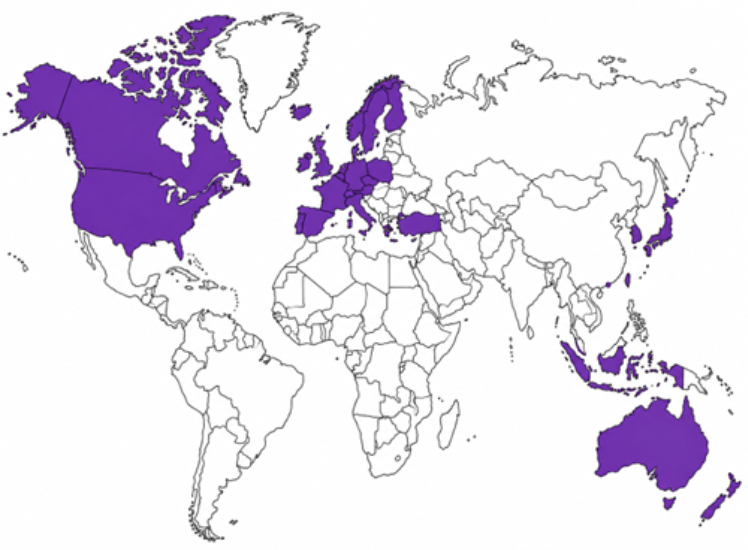
For a moment, let’s review how the “ITA World Map” evolved. In the years leading up to the negotiations culminating in Singapore, four countries in the northern Pacific region had signed agreements that would later set the stage for the ITA itself. Those agreements were the U.S.-Japan Semiconductor Agreement, the Canada-U.S. Free Trade Agreement, and NAFTA. The “Early ITA”, loosely speaking, looked like this –
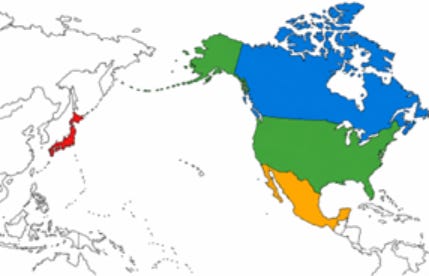
By the end of the NAFTA negotiations, these four countries accounted for approximately 37 percent of global IT trade according to the methodology that would have been used if these were the only ITA members in 1996 (Note: Mexico was not an ITA original signatory)
When Doug Worth and I first met with U.S. officials to discuss the possibility of negotiating an International Computer Agreement (ICA), we proposed adding the OECD countries to the four above. The “ICA World Map” would have looked like this –
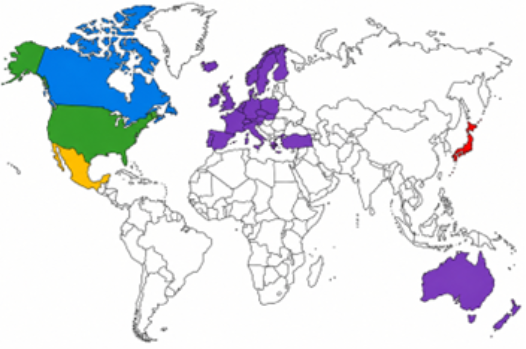
If the original four countries in the first map were joined by the OECD countries, the percentage of global IT world trade which they have made up would have accounted for about 77 percent. (Notes: According to the WTO methodology, the intra-European trade between the 15 members would have been included in the Critical Mass calculation, even though for membership purposes, the EU was counted as one member).
That was our original thought about ICA. Negotiate an agreement on high-tech products that would cover the world’s biggest markets; i.e., the OECD countries. But for the most part, we had not thought much about the “free rider” problem described above. One business person who was very involved with the Coalition did have a premonition about the desirability of going beyond the OECD for potential members. That was Doug Worth.
Doug knew that two weeks before the scheduled opening of the Singapore Ministerial, the Asia-Pacific Economic Council (APEC) had its fourth major economic leaders scheduled to be held in Manila and Subic Bay, Philippines.. APEC was an international forum of 18 member economies who were dedicated to advancing economic integration, growth, and free trade in the Pacific region. He also knew that a friend of his, Roberto “Bob” Romulo who was the President of IBM Philippines, had been deputized by Philippine President Fidel Ramos to organize private sector involvement.
Bob Romulo was no mere participant in the APEC meeting. He served as the founding Chairman of the APEC Business Advisory Council (ABAC). He created the 1996 APEC Business Forum, a conference that brought over 400 global CEOs to Manila to interface with the government ministers themselves – an unprecedented opportunity in which Romulo aggressively advanced the idea of faster regional trade integration.
Doug’s own role in Manila stemmed not just due to his friendship with Romulo, but also from his role as a Trustee of the Asia Society, an organization that promoted major business forums along the APEC summits to bridge Western corporations with East Asian trade ministers. In Manila, Doug and Bob worked diligently to get the APEC Summit to formally endorse the ITA.
The APEC endorsement had a major impact in Singapore. Admittedly, the APEC economies included the 4 major economies we focused on previously (U.S., Japan, Canada, and Mexico), but they also included a number of what were in those days called the “Asian Tigers.” These included countries, among others, like Hong Kong, Malaysia, Philippines, Singapore, South Korea, Taiwan, and Thailand. All of these were up and coming stars in the rapidly evolving global IT industry.
Their ITA support had a profound impact at the Singapore Ministerial. Some reports suggest that APEC’s united front helped to break deadlocks between the United States and European Union over product coverage and tariff deadlines and transitions. There is, however, nothing to document this since those discussions were held in private talks. But in addition, the dominance of the APEC countries’ manufacturing helped to convince the 29 original signatory countries to sign the ITA in Singapore (NOTE: Not all APEC countries, however, would sign the ITA at that time).
The point is this: The ITA would not be a “big boys” club. The U.S. and EU were determined not to let that happen.
During the Singapore negotiations, Barbara Chattin told Jim Whittaker and me what that meant. A “critical mass” of countries accounting for at least 90 percent of world trade volumes must formally sign the ITA by April 1, 1997. According to Chattin, the fact that the “Asian Tigers” pushed for adoption of the ITA gave Charlene Barshefsky a certain sense of optimism that this goal could be reached. Still, she said, they were looking to the Coalition to help make it happen.
IBM Acts
Previously, IBM’s organization was described here – material about the three major World Trade Corporation subsidiaries (the Europe/Middle East/ Africa Corporation, the Asia/Pacific Corporation, and the Americas/Far East Corporation) was briefly discussed. As shown, IBM Corporation with headquarters in Armonk, New York, was the point at which it all came together. The staff positions in the subsidiaries closely mirrored that of the Corporate staff. The three subsidiaries and most of the major country organizations around the world had staffs that were responsible for establishing and maintaining good relations with government officials.
Whether named External Programs, or Public Affairs, or something else, these offices reported directly to country general managers and took “advice and counsel” from the Corporate (CHQ) Governmental Programs staff in Washington, DC. In other words, the local offices in the countries did not report directly to us in Corporate, but it is safe to say we were a close knit group. Every year, the Washington Office would host a global Governmental Programs meeting with representatives from all subsidiary and country organizations where issues of common interest and programs to address them were discussed and loosely coordinated.
I had been fortunate enough to have been one of the first two people ever to be employed in the Washington Office. I had been in that office (or on assignment to our offices in Paris, Brussels, and Hong Kong) for over two decades and worked on a daily basis to coordinate our efforts on matters of international trade policy. During those first two decades (and the following decade), our response in Corporate and our overseas to the ITA “critical mass” issue raised by the WTO was unmatched.
Already, we have covered how IBM organizations had been innovative in its use of internal email. In fact, use of the intra-office email system called PROFS was pioneered by our Governmental Programs office. We had started small, but within a very short time, we had encouraged our subsidiary organizations involved in Governmental Programs to adopt the use of PROFS and to use it on a daily basis.
For Singapore, our internal networking via PROFS, telephones, and fax was unrivaled. And as mentioned, even the officials in USTR and the Commerce Department saw the promise available in communications technology.
And that is the system we kicked into high gear when Barbara Chattin relayed Charlene Barshefsky’s message that the original 29 signatory countries to the ITA were insufficient to represent more than 90 percent of global IT trade volume. In actual fact, Chattin told us that the percentage should be 92 percent just to be sure, but the official target was 90. This is the ITA Signatory map that Chattin told Jim Whittaker and me was on the table (we shared it with Doug Gregory of IBM Canada) –
For IBM, it’s true that those 29 countries were countries where we had our largest country organizations.
Even before we left Singapore, Doug Gregory and I suggested that the Washington Office convene a conference call of the major headquarters locations – those where we knew that we had exceptionally strong leadership. These were IBM Europe offices in Paris and Brussels, IBM Asia/Pacific offices in Mount Pleasant, New York, Tokyo and Hong Kong, IBM Canada in Toronto, and, of course, the Corporate office in Washington. In that call, Doug and I laid out the challenge – how to launch and coordinate what amounted to a global lobbying initiative on a single issue. We had never done it before.
During the next three months, the Country General Managers and Governmental Programs executives made an unprecedented number of contacts with their respective governments – primarily trade ministries – encouraging them to inform the WTO of their willingness to sign on to the ITA. We focused on a number of key Asian and European/Middle East countries, where IBM had operations that ranged from procurement to key sales to limited assembly and manufacturing. From our Washington office, we made extensive use of our PROFS email network and bi-weekly conference calls to monitor progress in our country contacts abroad.
We were disappointed that by the time that the formal adoption of the ITA was announced only Costa Rica in Latin America had joined the list, and surprisingly, Mexico did not (and to this day still limits its role to a kind of observer status and using an “ITA Plus” tariff elimination program).
Of course, IBM cannot claim sole or even the lion’s share of credit for the countries that did decide to join after Singapore, but we were pleased that many of those we had prioritized for contacts did indeed join in time to meet the deadline. And going back to the early efforts of Doug Worth and Bob Romulo, quite a large number of APEC members signed on to the agreement.
On March 3rd, Renato Ruggiero announced that negotiators had received commitments from countries representing more than the 90 percent “Critical Mass” threshold. But the critical date came just over 3 weeks later on March 26, 1997, when the formal agreement was reached representing 43 countries accounting for 92 percent of IT trade (WTO announcement).
The Information Technology Agreement was formally adopted.
In making the announcement, Ruggiero commented:
…the importance of the agreement goes well beyond statistics. The impact of these agreements on improved living standards for the world’s citizens should not be underestimated. The computers, semiconductors, telecoms hardware and computer software that are included in the ITA are the conduit for the delivery of information. By making such products more affordable, we move one step closer to the vision of a telephone in every village of the world. The ramification of such an achievement to the health and education of those in the poorest countries are obvious.
On June 30, 1997, President Clinton used his residual executive authority under the Uruguay Round Agreements Act to proclaim that the ITA tariff reductions and eliminations would go into effect immediately and be completed by the year 2000. Clinton had been a big supporter of the ITA. Even at the conclusion of the Manila APEC conference, he told the U.S. embassy staff there that information technology was “to the 21st century what highways and railroads were to the 19th century,” and told them to “imagine if we went to zero tariffs in the entire world.” Charlene Barshefsky, throughout the balance of the Clinton Administration’s term of office, frequently spoke in public forums and in testimony before Congress about the importance of the ITA, noting that it was the central driver of global internet commerce.
Loose Ends
There were still a few loose ends to tie up for the Coalition and for IBM. Mentioned previously was the opposition of the domestic capacitor industry to its products’ inclusion in the agreement. Representatives of that industry – almost all based in South Carolina – complained to USTR and the House & Ways Committee that they had not been consulted on the product “landscape.” This was not true. Two of the capacitor industry companies were members of the Semiconductor Industry Association, and SIA was able to document a number of cases where they sent notices to their members about the product scope. Eventually, with USTR strongly backing the Coalition on this point, the capacitor industry backed off.
The Coalition also had to wrap up things with Capitol Hill. The staffs of the House Ways & Means and Senate Finance Committees, in their oversight roles, requested detailed briefings on the iTA. Meghan Rainey, Joe Tasker, David Rose, and I represented the Coalition and met with them to answer their questions. This led to hearings about the ITA by both committees. I testified in both sets of hearings in generally amiable sessions.
The final day of the ITA Coalition’s work concluded with my testimony before the Finance Committee. Senator Daniel Patrick Moynihan spoke at length about IBM in the state of New York, and said in conclusion words to the effect that it is because of forward-looking companies like those in the Coalition that their leadership on free trade means that “the United States remains the strongest economy in the world.”
The Information Technology Agreement – Not Done Yet
The Coalition’s work was over, but its effect continued to grow. What started as a desire to expand a simple idea from NAFTA (the CXT) had ballooned in the course of a couple of years to a major global movement promoting free trade for an entire industrial sector, The ITA challenged conventional practices in trade policy and advocated fiercely a global trading system that was responsive to – and sometimes prepared in advance for – the realities of global networking, global supply chains, and global information exchange.
By March 1997 adoption, 54 countries had signed the ITA (counting the EU member states as separate countries), accounting for 92.5 percent of global trade in IT. Still, even though the work of the Coalition was over, its impact continued to grow. Every member country today had its own reason for joining, but two members are important to note due to their political and economic influence in the world –
China: China’s ITA membership was closely tied to its WTO accession with its accession taking effect and its ITA participation was formally approved on April 24, 2003. The ITA made a lot of sense for China. The country was developing into a major electronics manufacturing and assembly center, so zero tariffs brought down the cost of ITA products thereby making the Chinese assembled and manufactured products less expensive. In actual fact. China did not simply decide to become a member in 2003. The ITA Committee of the WTO initially blocked its participation because China required end-use certificates for certain IT products. This was objected to by the U.S. and other members, so China modified its procedure in a way that allowed the block to be removed. So, bottom line: China did not simply decide that zero tariffs were a good idea. Joining the ITA had become part of a much larger bargain through which China joined the WTO and integrated itself into the global trading system.
Russia: Russia joined the WTO on August 22, 2012, and committed specifically as a condition of membership to reduce its IT product tariffs from 5.4 percent to zero. At that time, where China was becoming a major producer and exporter of IT-related manufactured goods, Russia was principally a consumer – a large market for imported IT products.
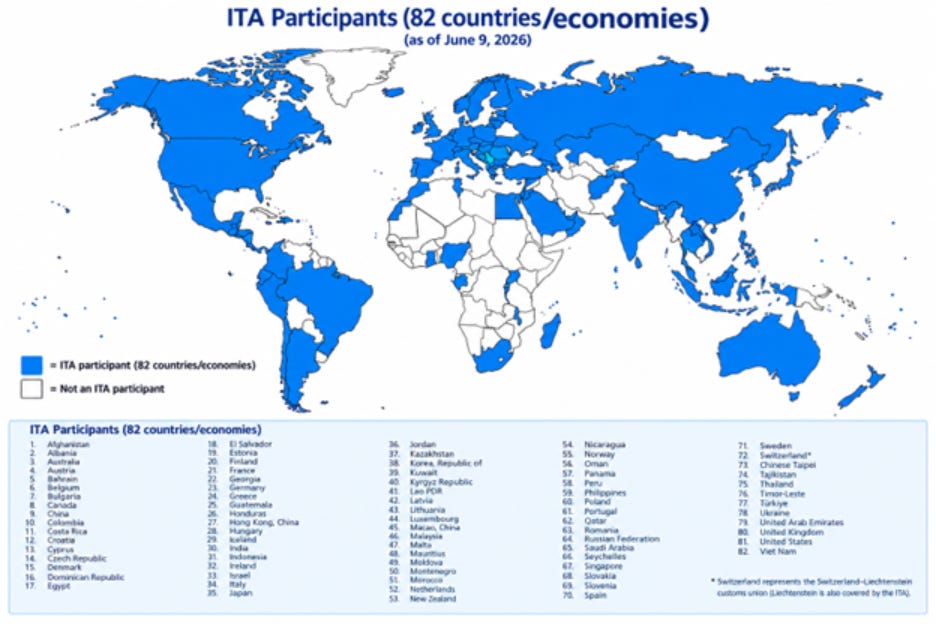
Today (September 2026), 84 WTO countries are ITA participants (counting the 27 EU member states individually rather than treating the European Union as a single participant). These 84 account today for about 97 percent of global trade in IT products.
The ITA World Map Today looks like this –